


What Every Food Business and Food Handler Should Know About Plastic Gloves
Eco Gloves

“When I think of the best days of my life, I think of my birthday, wedding, child’s birth, and… I think of the time I didn’t get sick. That’s thanks to my go-to restaurant and food service partner using eco-friendly gloves to prepare my food.”
In the food service industry, getting this kind of feedback from patrons and customers is definitely fulfilling and a big feather in the cap.
However, serving clean non-toxic food nowadays has never been more challenging. Evolving pathogens, for one. Shortages in cleaning supply, another.
But most of all, the plastic gloves we commonly use to handle food and supposedly prevent contamination turned out to be harmful not just to human health but also to our beloved Mother Earth.
How so? Let’s find out.
Topics Covered
- Mother Earth is choking on plastic
- The ugly side of plastic’s lifecycle
- The effects of plastic waste on the environment and our health
- Plastic gloves don’t belong in the kitchen
- Say goodbye to toxic gloves and say hello to Eco Gloves
- Key Takeaways: Why Food Businesses Should Avoid Plastic Gloves
-
Frequently Asked Questions About Plastic Gloves in Food Handling
Mother Earth is choking on plastic

To begin with, let’s unveil the problem we’re dealing with globally ⸺ plastic waste.
The first fully synthetic plastic was invented in 1907. And since then, production has grown exponentially. In fact, plastic produced in the first decade of this century eclipses the total produced in the last century.
Today, about 400 million tonnes of plastic waste are produced yearly globally according to the United Nations Environment Programme (UNEP).
If current trends persist, scientists predict that by 2030, 53 million tonnes of plastic waste will overwhelm our oceans each year. And The Ellen MacArthur Foundation says there could be more plastic than fish (by weight) in the ocean by 2050.
Speaking of plastic waste, one of the biggest contributors is disposable plastic gloves. And the pandemic exacerbated the issue.
For instance, Wuhan hospitals alone produced more than 240 tons of single-use plastic-based medical waste (face masks, gowns, gloves) daily amidst the outbreak ⸺ 6 times more than their average pre-COVID. Moreover, Top Glove, the largest glove manufacturer, spiked in production which is now at 100 billion gloves per annum.
That said, the plastic glove sector has become a major polluter adding injury to the already bad global plastic waste crisis.
The Environmental Science & Technology study even revealed that 65 billion gloves were being disposed of monthly globally in 2020. Again, that’s in billions with a “B”.
Now, the question might be, “Should we care?”
Well, like Newton once said, “For every action, there is an equal and opposite reaction.” Or Karma, in the philosophical sense.
For that reason, turning a blind eye makes our demise nigh. Once nature decides it’s had enough, humanity will find itself on the list of extinct species. Unless, of course, we do something about it (more on this later).
The ugly side of plastic’s lifecycle
From the start, plastic gloves production generates massive amounts of greenhouse gas (GHG). And when you think chucking them in the bin is the end of the story, it’s just getting started ⸺ “end of life” doesn’t mean “end of impact”.

Believe it or not, only 9% of plastics are recycled. The rest are either incinerated (creating serious air pollution) or dumped in landfills and natural environments where they continue to emit harmful gasses. Not for years but centuries even millennia.
Eventually, plastic waste reaches our oceans where they break down into microplastics.
A recent oceanographic study led by Kyushu University found that roughly 24.4 trillion pieces of microplastics are in the world's upper oceans. To put that in perspective, that’s about 30 billion 500ml water bottles full of microplastics!
And note, that’s just in the oceans’ upper layer… what more if they search the abyss?
The effects of plastic waste on the environment and our health

As plastic waste cram landfills beyond their capacity, expansion could mean sacrificing wildlife habitats. And as plastic chemicals leach into the earth, groundwater becomes undrinkable.
On top of that, myriads of ocean plastics poison marine wildlife. In fact, millions of marine animals are already getting killed by plastic pollution every year.
Thereby, here’s another major problem ⸺ seafood contamination. That’s because fishes mistake microplastics for food.
Most of us consume fish and other marine products so inevitably, we end up eating bits of plastic waste, unfortunately. Toxic compounds such as phthalates and bisphenol A (BPA) are then absorbed by our bodies messing up our hormones and physiology.
What’s more? Pathogens like the Vibrio spp. can bind to microplastics making them a medium for diseases to spread far and wide (we all know how that goes). There’s even a report that microplastics are now in the human placenta.
With such alarming facts in mind, here’s the point…
As much as possible, plastic gloves should be avoided like the plague because the negative impacts last for eons on a global scale.
Plastic gloves don’t belong in the kitchen

Given the fact that the food service industry is among the top 3 glove consumers, the more sensible and responsible we should be in our decision-making.
Here are other downsides to plastic gloves you probably didn’t know:
⚠️ Often thin and low quality
Mass production focuses on quantity over quality.
⚠️ Petroleum-based
Puts strain on non-renewable resources making it unsustainable
⚠️ Has potential to cause allergic reactions
Synthetic and toxic ingredients in the materials have higher potential to cause skin sensitivities
⚠️ Cause contact dermatitis
Culprit is the plastic ingredient itself, polymer, and additives like glove powder.
⚠️ Contain and emit toxic chemicals
Toxic chemicals leech into our bodies and environment leaving lasting negative effects
The Coalition for Safer Food Processing and Packaging has found ortho-phthalates in vinyl (PVC) gloves used by some major food services and fast-food chains. Getting your business red-flagged due to toxic PPEs is something you don’t want.
Bare hand contact with food indeed contributes to foodborne disease transmission. Thus, all food handlers ⸺ anyone who has direct contact with food (from preparation to delivery) ⸺ must wear gloves.
However, since plastic gloves are now a no-go, it’s time to embrace sustainable green alternatives.
Say goodbye to toxic gloves and say hello to Eco Gloves
Going back to the customer feedback at the beginning, the specific term used was, “eco-friendly gloves”. And that’s for a reason.
It wasn’t “plastic gloves” because that would have resulted in chemically contaminated food and more sick days.
Instead, it was pertaining to Eco Gloves.
Because unlike plastic gloves (Polyethylene, latex, vinyl, nitrile, etc.), Eco Gloves are:
💚 Manufactured responsibly and ethically

We take pride in a holistic approach from the production to the distribution phase, and from Rainforest Alliance Certified packaging to sustainable materials.
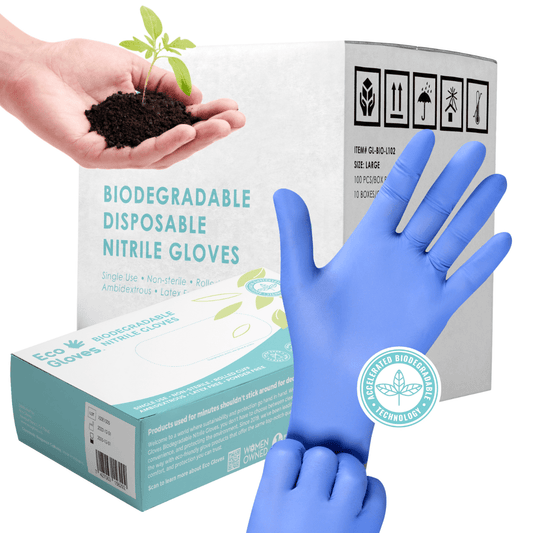
💚 Made from plant-based materials
Minimal carbon footprint.
💚 Compostable in a few months
Doesn't stick around for thousands of years (if not forever) like traditional synthetic materials
💚 Breaks down into rich soil (not microplastics)
Promotes more plant growth.
💚 Thick and durable
Reduces the possibility of contaminant penetration.
It’s time for a change in the food service industry.
Embracing better alternatives will go a long way in the fight against plastic waste. And caring for our customers' and workforce’s well-being will drastically increase productivity and performance ⸺ less sick days for everyone, and better business in the long run.
So, if you’ve finally decided to join the green and better alternatives bandwagon, Eco Gloves is here to help.
Check out our products and see which best suits your needs. Whether that’s gloves for personal needs or gloves for the entire company, we’ve got the best deals for you.
Time to be a part of the solution, not the problem. Together we can… one eco-friendly glove at a time!
Got questions or need assistance? Feel free to hit us up through this form. We’d love to hear from you!
Key Takeaways: Why Food Businesses Should Avoid Plastic Gloves
-
Major Contributor to Plastic Waste: Disposable plastic gloves add billions of units of waste globally each month, worsening the plastic pollution crisis.
-
Environmental & Health Risks: Plastic gloves can release toxic chemicals, contribute to microplastics in oceans, and even enter the human food chain.
-
Unsustainable Materials: Petroleum-based production depletes non-renewable resources and generates high greenhouse gas emissions.
-
Potential for Skin Reactions: Vinyl and other synthetic materials may cause allergic reactions or dermatitis.
-
Low Quality & Durability: Many plastic gloves are thin, tear easily, and fail to offer reliable protection.
-
Eco-Friendly Alternatives Exist: Compostable, plant-based gloves like Eco Gloves offer durability, safety, and environmental benefits without leaving microplastics behind.
👉 By switching from plastic gloves to sustainable alternatives, food businesses can protect customers, workers, and the planet—while improving brand trust and compliance.
Frequently Asked Questions About Plastic Gloves in Food Handling
-
Why are plastic gloves harmful to the environment?
They are petroleum-based, non-biodegradable, and often end up in landfills or oceans, where they break down into microplastics over centuries.
-
Do plastic gloves pose health risks?
Yes. Some contain harmful chemicals like phthalates that can leach into food, and they may cause skin irritation or allergic reactions.
-
Why not just use bare hands with proper washing?
Bare-hand contact with food can spread pathogens; gloves provide an added layer of protection when used with proper hygiene.
-
Are all disposable gloves equally harmful?
No. Plant-based compostable gloves break down naturally and avoid the toxic impacts of petroleum-based options like vinyl or polyethylene.
-
What are better alternatives to plastic gloves for food service?
Eco-friendly compostable gloves made from plant-based materials, manufactured sustainably, and designed for durability and safety.
-
How can switching gloves benefit my food business?
It reduces environmental impact, improves food safety, protects worker health, and boosts customer trust in your commitment to sustainability.
Further Reading
- The Rise of Compostable Food Prep Gloves, Cups, Bags, and Straws: A Sustainable Shift for Businesses
- How Can Businesses Cash In on the Benefits of Compostable Gloves
- Disposable Gloves Product Tips & Usage Guide